Tic Clips aims to enroll about 1,000 children and adults living with tics. After joining the registry, you will be invited to participate in Tic Clips, if you are eligible. Tic Clips participants fill out surveys and submit a brief video of themselves. This helps us learn more about the full range of what tics can look like. There are other optional parts that might come later.
Study Flow
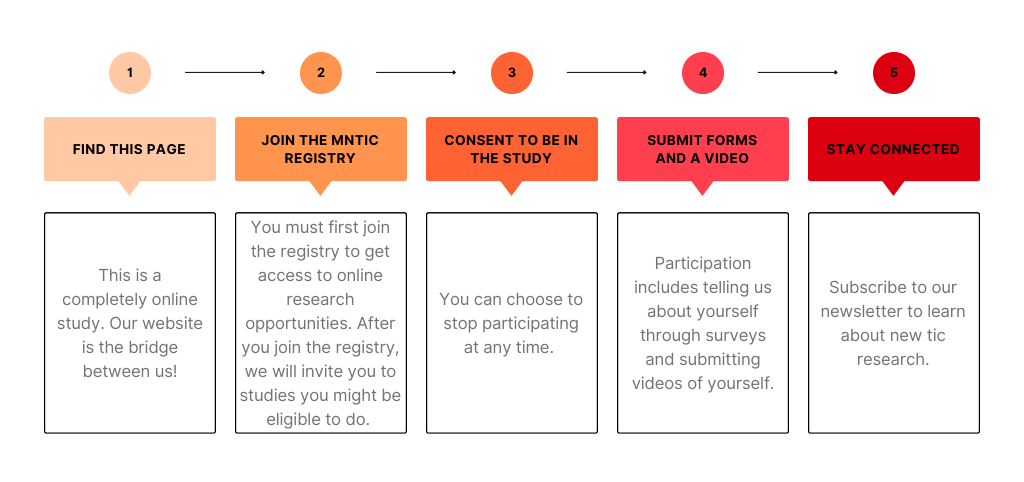
- People with tics ages 18 and older
- Parents of children with tics aged 4-17 years
- Adult participants or parents who read English
- People who have access to an internet connected devices that can record videos, like a computer, phone, or tablet with webcam
- People who are signed up for the MnTiC registry

Goal of Tic Clips
The goal of Tic Clips is to see if we can use video recordings to measure tics. We know tics can be really different across people. By getting a lot of videos of people doing tics, we hope to better understand the variety of tics that exist. We will also get videos from the same people over the course of a year so we can see how tics change. Another goal of Tic Clips is to create computer software that can tell the difference between typical movements and tics.
Why is it important?
Our hope is that Tic Clips will help us improve the way we identify tics in the future. Right now, doctors figure out if a person has a tic disorder by asking questions and watching the person’s movements. This process has some limitations. For example, different doctors might notice different tics, or a person’s tics might be different in the doctor’s office than at home. One goal of this study is to develop a digital tool that can help us reliability measure tics. Our hope is that a tool like this could improve the healthcare experience of people with tics.